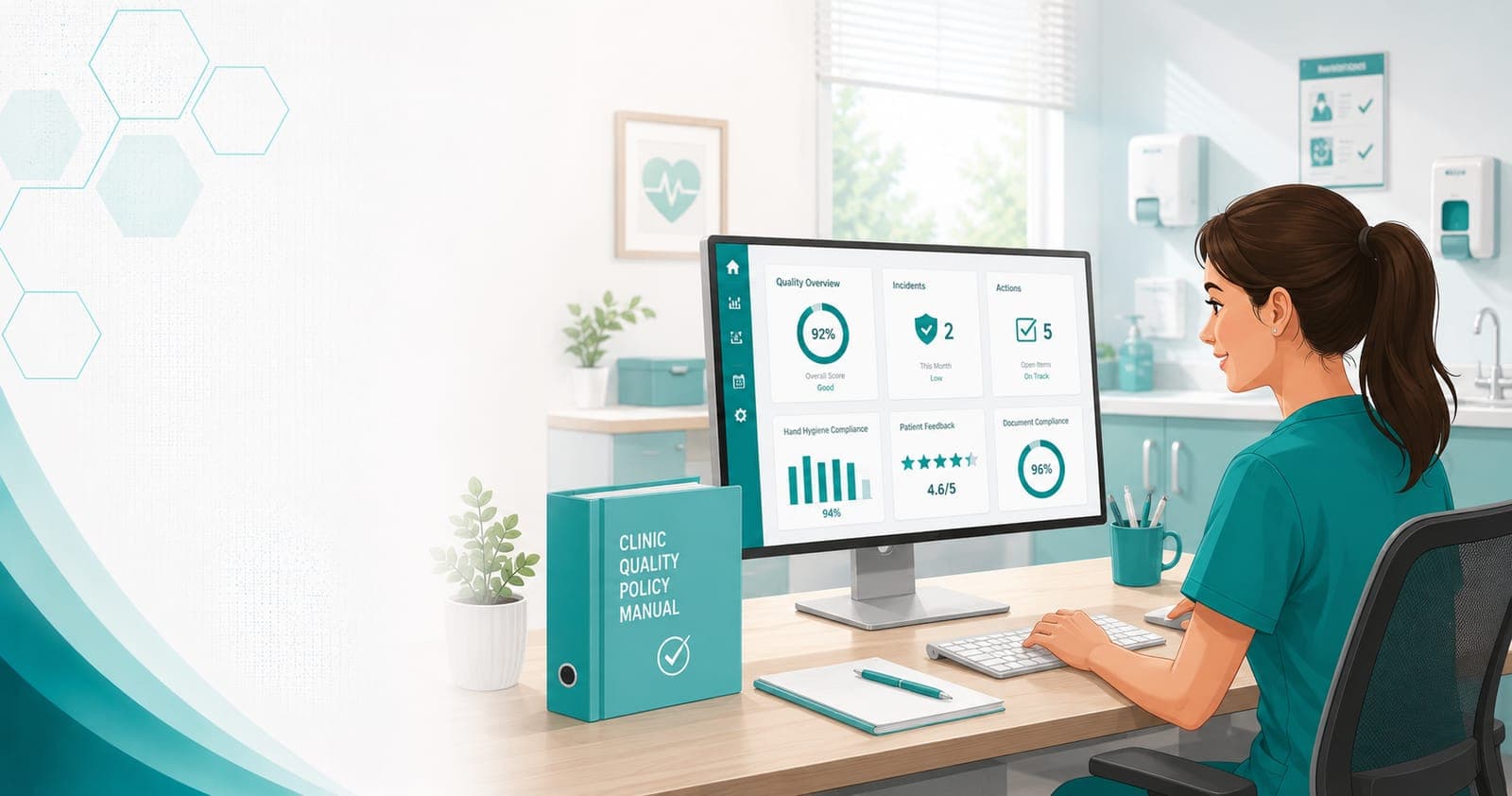
This series has walked the Quality Management System through a surgical facility, section by section. But here's the thing most clinics miss: the majority of that system isn't surgical at all. A non-surgical medical clinic (one preparing for a College of Physicians & Surgeons of Alberta (CPSA) IPC inspection, or simply wanting to run well) needs a real Quality Management System too. Just a right-sized one.
The skill isn't copying a surgical facility's binder. It's keeping the parts that apply, scaling them to your scope, and setting the rest aside — on purpose, and on the record.
What a clinic actually needs
- The QMS engine, scaled down. None of the core machinery requires an operating room: a named owner for quality, document & records control, a feedback & complaints loop, a non-conformance & CAPA process, and a handful of quality indicators and internal audits. For a clinic, this can be lightweight — but it has to exist.
- Infection prevention & control: the centrepiece. This is what a CPSA IPC inspection actually examines, and it maps onto a clinic almost unchanged: the IPC program and a trained lead, hand hygiene and the 4 Moments, PPE, environmental cleaning, and patient-care exposure control. (See the NHSF-framed IPC standard and the clinic-focused inspection checklist.)
- Governance and people. A defined structure, verified credentials, and confidential personnel records. The organization & personnel requirements are general HR, not surgery.
- The supporting pieces that scale. Information systems & data security, the equipment lifecycle, and the parts of pre-service that matter for any clinic: two-identifier patient ID, informed consent, and a complete record.
- Reprocessing, if you do it. A clinic that reprocesses reusable instruments inherits the medical device reprocessing standard, which is where a clinic inspection gets most exacting.
What a clinic can leave out — on the record
The genuinely surgical machinery doesn't apply to a non-surgical clinic: the sterile field and surgical hand scrub, the surgical safety checklist and count, the anesthesia workstation, recovery-room staffing ratios, and the laser or radiation safety programs (unless you operate those modalities). The move isn't to ignore them. It's to mark each one not applicable and document why, so an assessor sees a deliberate scope decision rather than a gap.
Why "right-sized" is the whole skill
- Over-build, and it becomes paper no one follows: the fastest way to fail an inspection is a binder of policies the floor doesn't match.
- Under-build, and the inspection finds the hole, usually in IPC, hand-hygiene auditing, or reprocessing.
- The clinics that pass calmly are the ones whose system is sized to exactly what they do.
How Zosimos helps
We right-size the QMS to your clinic: the IPC program an inspection expects, plus the lightweight document, feedback, CAPA, and indicator loop that keeps it real between visits — no heavier than your scope requires. The PolicyHUB, Accreditation Audit Tool, and Compliance Tracker we're building on the Zosimos Enterprise hub (launching soon) are designed to scale from a single clinic to a full surgical facility.
See our IPC & CPSA compliance support or get in touch to talk through what a right-sized system looks like for your clinic. And to keep whatever you build from going stale, read the series closer: keeping the QMS alive between cycles.
A right-sized system still has to hold up under inspection: the IPC and reprocessing self-check is the fastest way to see whether yours would.