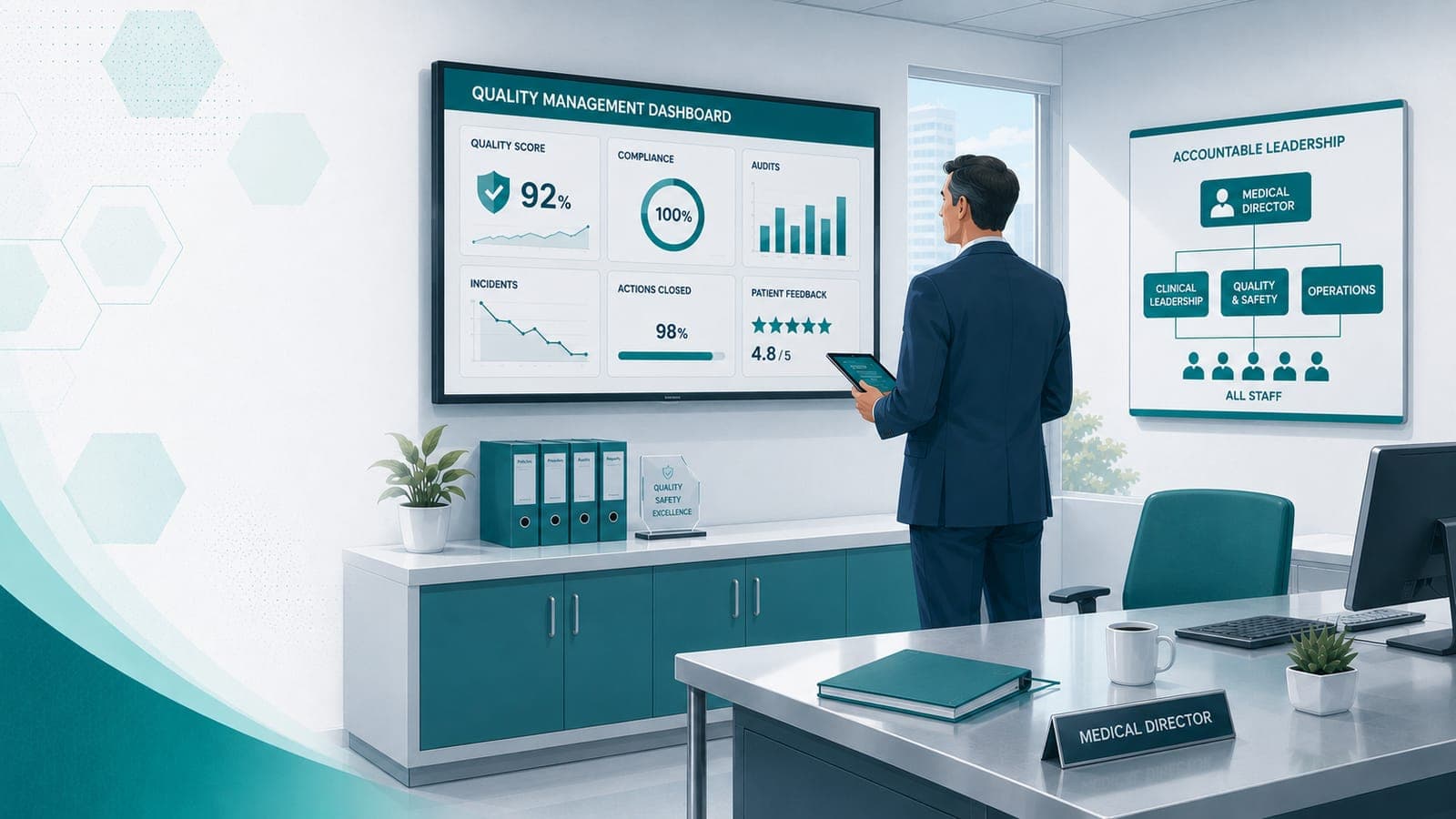
A Quality Management System is a loop of documents, audits, indicators, and corrective action. But a loop needs someone to turn it — and that's where the College of Physicians & Surgeons of Alberta (CPSA) standard begins. Before it asks for a single policy, it asks a simpler question: who owns the quality system, and do they have the authority to run it?
It's the first standard in the QMS section for a reason. Everything downstream depends on it.
What CPSA expects
In plain language, the standard asks for clear ownership and clear authority:
- A named owner. A specific person is formally delegated both the responsibility and the authority to run the QMS — not a committee in the abstract, but someone who owns it.
- A reporting line that reaches the decisions. That owner answers into the tier of facility leadership where policy and resourcing decisions actually get made. Quality has to have a seat where the money and the rules are set.
- Accountability for the system working. They make sure the processes the QMS needs are established, implemented, and maintained, not stood up once and left to drift.
- A quality policy that defines the system. The facility's written quality policies describe the organization and management structure (and its relationship to any parent organization), the quality policy itself, the scope of the QMS, management's responsibilities for compliance, and how the documentation is organized, and staff can access them and are trained on how to use them.
The guidance is explicit that this role can be filled by someone who wears other hats in the facility. In a small NHSF, the QMS owner is often a clinical or administrative leader who also does other work — what matters is the delegated authority, not a dedicated title.
Why "authority" is the word that matters
Plenty of facilities name a quality lead. Fewer give them the authority the standard actually requires, and that gap is where systems quietly fail:
- No authority to allocate resources. If the QMS owner can't secure time, staff, or tools, the audits and indicators never happen.
- No authority to act. When something unsafe surfaces, the owner needs the standing to halt the work, pull a document, or trigger corrective action — not raise it and hope.
- A reporting line that dead-ends. If quality reports into a layer that can't change policy or budgets, the improvement loop is broken before it starts. The standard's insistence on reporting to the decision-making level is doing real work.
Responsibility without authority is just blame waiting to happen. The standard deliberately pairs the two.
What good leadership of a QMS looks like
- A real quality policy, not a decorative one: a short statement of what the facility commits to, with the scope and roles spelled out.
- A management-review rhythm. Leadership periodically looks at the indicators, audit results, complaints, and non-conformances together, and decides what changes — closing the loop at the top.
- Resourcing the work. The owner is given the time and the tools to maintain the system, not asked to do it in the margins.
- A clear delegation trail, so when the owner is away, the authority and the responsibility are covered.
How Zosimos helps
We help facilities put a real owner (and real authority) behind the QMS: drafting the quality policy and management structure the standard expects, defining the reporting line, and setting up the management-review rhythm that keeps leadership engaged between accreditation cycles. Where leaders are flying blind between surveys, we build the dashboards that put the QMS in front of them.
That's part of the integrated compliance platform we're building on the Zosimos Enterprise hub: PolicyHUB (an electronic policy library), an Accreditation Audit Tool, a Compliance Tracker, and more, launching soon. If you want leadership to see the quality system, not just sign off on it, we'd be glad to show you where it's headed.
New to the series? Start with what a QMS really means. When you're ready, see our CPSA NHSF accreditation support or get in touch to talk through who owns quality in your facility today.
Governance is the first thing an assessor probes. Our free surgical facility readiness check will tell you whether yours is documented well enough to survive that conversation.