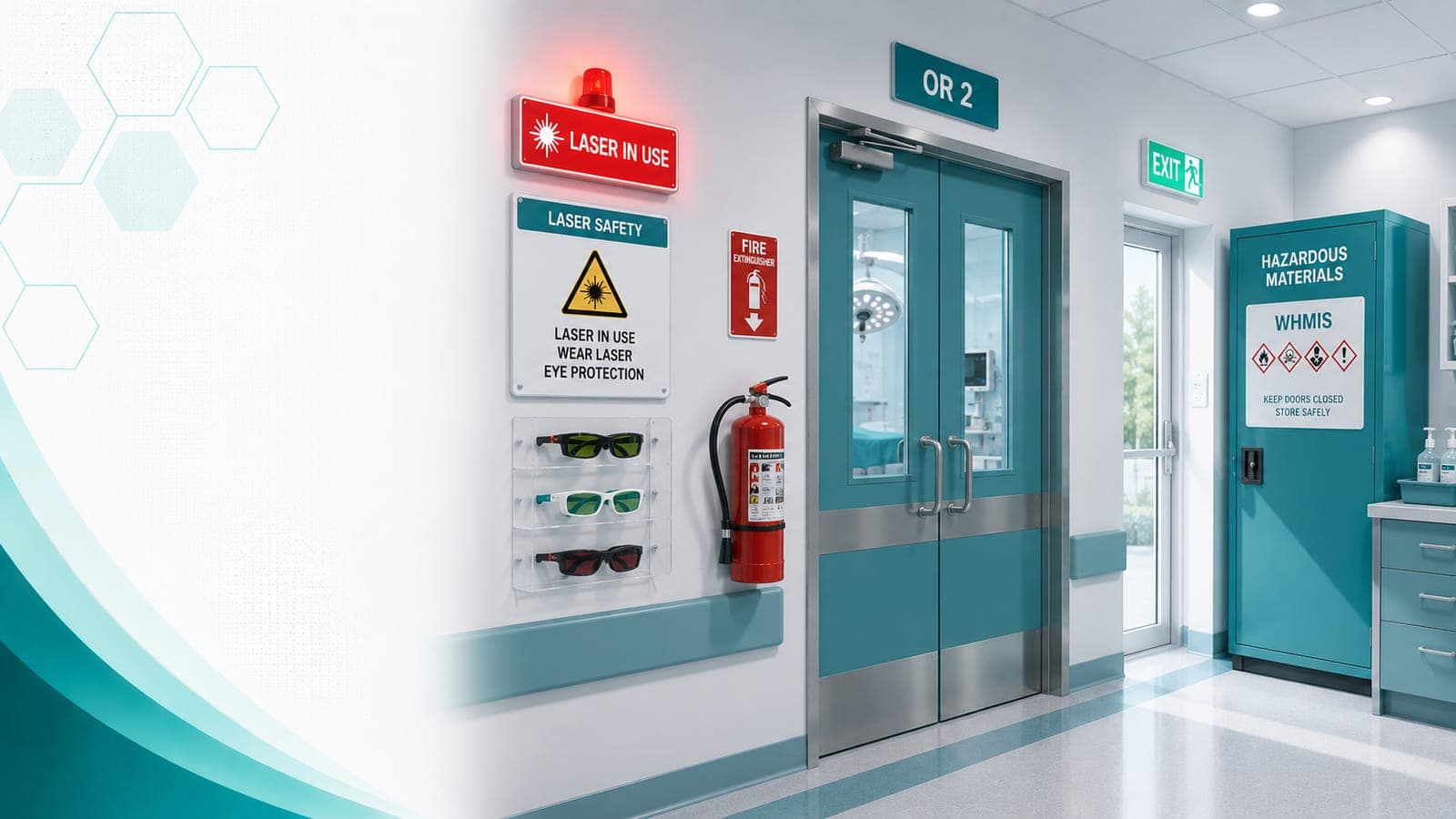
"Safety" can sound like a poster on a wall. In the College of Physicians & Surgeons of Alberta (CPSA) standard it's one of the largest chapters in the document (NHS.10.0) and it's built like a system: owned, programmed, trained, audited, and specialized where the work demands it. It runs alongside the rest of the Quality Management System and your emergency preparedness, and it covers everyone in the building, not just patients.
What CPSA expects
- An owned, resourced safety program. The medical director is ultimately accountable; named safety personnel are given real authority to act on problems; and there's a complete written program scaled to the facility's work.
- A physically safe environment. Enough unobstructed working room, adequate lighting with tested emergency lights, temperature/humidity and ventilation control, noise minimization, ergonomics, and emergency evacuation controls.
- A program that's audited and inspected. Written health-and-safety plans kept current and available, a documented annual audit of the program with follow-up, periodic safety risk assessments, an annual physical inspection of all work areas, and defined record retention.
- Hazard identification. Recognized hazard and statutory signage, warnings to contractors, a non-retaliatory hazard-reporting process, and identification of hazards specific to pregnant workers.
- Safety training and incident management. Training tailored to each role, and a process to identify, document, investigate, and report safety and occupational incidents confidentially.
- Protected people. A staff immunization program built on exposure risk, safe personal-practice rules in clinical areas, appropriate footwear, fit-tested respiratory protection, a first-aid program, and accessible, tested eyewash stations and emergency showers.
- Hazardous materials under control. WHMIS compliance with current Safety Data Sheets and labels, secured chemical storage with a maintained inventory, biohazard precautions, safe sharps handling (engineered devices, no recapping), safe compressed-gas and cryogenic handling, and stocked spill kits.
- Modality-specific programs where you have them. A full radiation safety program (ALARA, dosimetry, shielding) for imaging, and a full laser safety program (a laser safety officer, protective eyewear, CSA Z386 alignment, non-beam hazard control) for laser procedures.
- Fire safety and waste disposal. Fire policies and regular drills, posted exit routes, fire-safety training, and maintained extinguishers — plus compliant segregation and disposal of biomedical, chemical, and general waste.
Why facilities struggle with it
- The program exists but isn't audited. Plans are written; the annual documented audit and inspection that prove they're alive are missing.
- WHMIS goes stale. Safety Data Sheets aren't current or accessible, and the WHMIS program's annual review — plus initial and update training — gets skipped.
- Drills don't happen — or aren't recorded. Fire and evacuation readiness is assumed rather than practiced and documented.
- Modality programs are thin. Facilities with a laser or imaging treat safety as the equipment vendor's job rather than a documented program with an accountable officer.
What "getting it right" looks like
- A named owner for safety with authority, and a written program audited and inspected annually with closed-out actions.
- Current, accessible WHMIS/SDS, a maintained chemical inventory, and engineered sharps safety.
- Documented fire drills and posted, unobstructed exit routes.
- For lasers or imaging, a real safety officer and program, not just equipment.
How Zosimos helps
Safety is a documentation-and-cadence problem as much as an equipment one — exactly where we help: building the written program, the audit and inspection schedule, the training matrix, and the SDS/chemical and incident records. The Compliance Tracker and Assets Management tools we're building on the Zosimos Enterprise hub (launching soon) are designed to schedule the audits, drills, and inspections and keep the safety records retrievable.
For non-surgical clinics: the management, written-program, training, hazard-ID, incident, first-aid, WHMIS/hazardous-materials, sharps, fire, and waste requirements all scale down directly. The radiation and laser programs apply only if you operate those modalities.
See our compliance & accreditation support or get in touch if your safety program is written but never audited. Next in this series: infection prevention & control.
Safety programs are assessed as a system rather than a set of documents. Our free readiness check for surgical facilities reflects that.