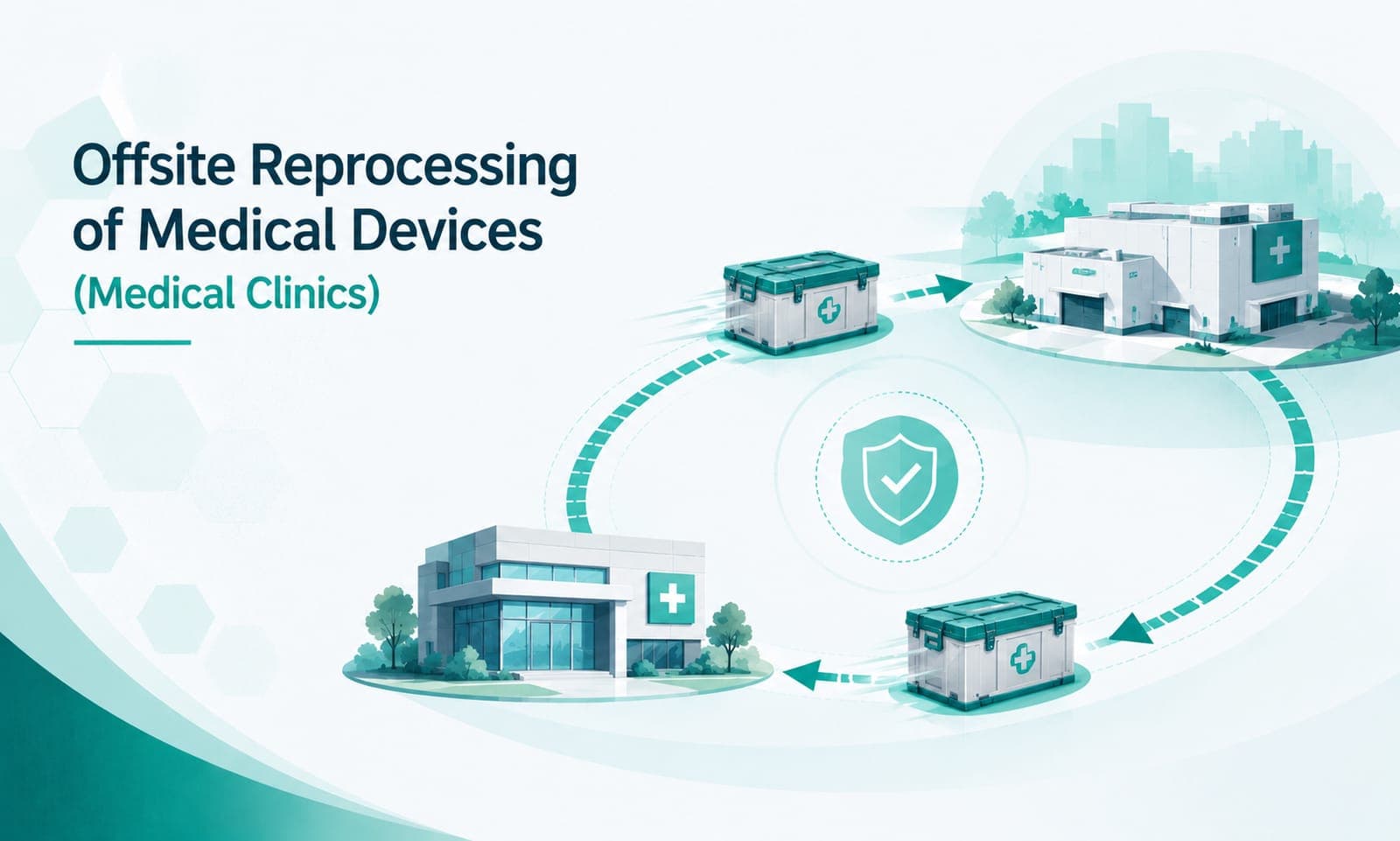
Not every Alberta clinic that uses reusable instruments can (or should) run a full sterilization program in-house. Some send their devices to another site to be reprocessed. That is allowed. What trips clinics up is the assumption that handing devices to someone else also hands off the responsibility. It does not. Under CPSA's guidance, the physician at the originating clinic stays accountable for the whole chain, and an inspector will look for the paperwork that proves it. Here is the offsite reprocessing protocol, end to end.
This article is for community medical clinics regulated by CPSA's IPAC Program. It is Alberta-specific guidance for independently operated clinics, not a pan-Canadian rule, and not the accreditation process for non-hospital surgical facilities. If you run a surgical suite, see our companion piece on reprocessing in an NHSF.
What "offsite reprocessing" actually means
Offsite reprocessing (CPSA also calls it third-party reprocessing) is when contaminated reusable devices are transported from your clinic to a different location to be cleaned, disinfected, or sterilized, then transported back. It is a partnership between two sites. A small community clinic that performs the occasional minor procedure, but has neither the volume nor the equipment to justify its own sterilizer, is the typical candidate.
The arrangement is permissible. But it adds two new failure points — transport and a second set of hands — on top of everything reprocessing already demands.
The core principle: the originating clinic stays responsible
This is the part to internalize before anything else. Offsite reprocessing is permitted, but the originating-clinic physician still owns every step (the preparation before the devices leave, the reprocessing done elsewhere, and the trip in both directions), and CPSA holds them to that. CPSA's Reusable & Single-Use Medical Device Requirements still apply to your clinic. Sending devices elsewhere does not exempt you from them.
Practically, that means the load records, the tracking, and the proof that monitoring passed all have to be available at your clinic, even though the sterilizer that produced them sits somewhere else.
Before you start: notify CPSA's IPAC Program
You are expected to notify CPSA's IPAC Program before you engage another location for offsite reprocessing — not after. CPSA needs to be aware of the responsibilities and processes at both sites. Before you make that call, work line by line through CPSA's Self-Assessment Tool for Offsite Reprocessing to see where your arrangement already meets the requirements and where it still has gaps.
- Email: ipac@cpsa.ab.ca
- Phone: 780-969-5004
Reaching out early is the point. This article walks the steps, but it is not a substitute for CPSA notification or the self-assessment tool. CPSA, not a checklist, is the compliance authority here.
The seven gates CPSA verifies
When you set up an offsite arrangement, CPSA looks for seven things to be in place:
- A written agreement between the two locations.
- Confirmed roles and responsibilities for the staff at each site.
- All reprocessing steps accounted for across the two clinics: no step falling into a gap between them.
- A copy of the manufacturer's instructions for use (MIFU) at both sites, for every device being reprocessed.
- Appropriately trained and educated staff at both sites.
- Written, clinic-specific policies and procedures.
- A written recall process that addresses any failure of chemical and/or biological monitoring.
That last one matters more than it looks. The recall process is specifically for monitoring failures (a failed chemical indicator, a positive biological indicator), and a recall by its nature has to be able to reach devices that have already been released. (Recurring documentation and tracking gaps are among the most common findings clinics face; see the top MDR inspection deficiencies.)
Choosing an offsite location
CPSA does not keep a public list of offsite providers and does not endorse vendors — you identify the location, and the physician remains accountable for the choice. Acceptable types include:
- An AHS or AHS-contracted Medical Device Reprocessing / Central Sterile Reprocessing department (for example, a hospital).
- A community clinic recently assessed by CPSA's IPAC Program.
- The MDR area within a CPSA-accredited non-hospital surgical facility.
- A dental or podiatry facility may be suitable.
Animal-care and veterinary settings are not acceptable. And the offsite location does not get to opt in blindly: it must obtain, review, and be capable of following each device's MIFU before agreeing, and CPSA will engage that location and must deem it compliant. If reprocessing is handled by a subcontractor (internal or external), the subcontractor must comply with CPSA's requirements too.
The exception: flexible endoscopes never go offsite
This one is absolute. Flexible endoscopes must not be reprocessed offsite. They have to be reprocessed right away once a procedure ends, and they are delicate enough that the transport itself can damage them. CPSA governs them separately, under Part D of its MDR Requirements. There is no version of an offsite arrangement that includes a flexible endoscope.
At the originating clinic, Part 1: preparing the devices
Everything that happens before the devices leave your building is on your staff. Three rules:
- Sharps stay home. Any used sharp goes straight into a sharps container at the table where it was used. Your staff handle this, and a contaminated sharp never travels to the offsite site.
- Pre-clean (wipe) gross soil at the point of use. Remove visible soil right away, typically by wiping the used device with moistened disposable gauze or similar.
- Keep devices moist. Soil and organic matter must not be allowed to harden. Place devices in a container and apply an instrument gel, spray, or foam (or moist towels), always following the chemical product's labelled instructions and the device MIFU.
At the originating clinic, Part 2: the transport-out container
The container that carries contaminated devices out has to be:
- A rigid container that is leakproof, can be securely closed, and is easy to clean.
- Clearly labelled and designated for contaminated devices only: for example, marked "contaminated devices only."
- Unable to open accidentally in transit, and built so no one could ever take its contents for clean or ready-to-use instruments.
It is cleaned and disinfected after each use, typically by the offsite location, since that is where the soiled container is emptied.
Who actually cleans the devices
There is one step you must never leave ambiguous. Cleaning (the physical work of brushing instruments immersed in a sink, rinsing, and drying) is expected to occur at the offsite location. But both sites have to settle, in plain terms, which one of them owns the cleaning, rinsing, and drying. Cleaning is the step that makes sterilization possible at all; if each site assumes the other did it, devices go through a sterilizer still soiled. The written agreement is where this gets nailed down.
At the offsite location: receive, clean the container, reprocess
When the devices arrive at the offsite site, that site:
- Receives and inventories the devices on arrival.
- Cleans and disinfects the soiled transport container — interior and exterior.
- Cleans, rinses, dries, and disinfects, or sterilizes the devices, then packages them for return.
Documentation and tracking: parameters, BI results, load reconciliation
This is where the "you're still responsible" principle becomes concrete. The sterilizer's own readings — cycle time, temperature, and biological-indicator (BI) results — get tracked, logged, and retained at the offsite location. But CPSA requires that the offsite location's sterilization tracking information be available at assessments of your clinic (the originating clinic), and load numbers on packages stored at your clinic are reconciled against the offsite site's records. The way the two reconcile: each returned package carries a load number, and those load numbers on packages stored at your clinic are matched back against the offsite site's records.
So the offsite location should give your clinic copies of all documentation, and is recommended to keep a separate tracking record for each clinic it serves. The supporting records that should exist include packages labelled with sterilizer number, load number, and date; a cycle-parameter printout or electronic record; a load-control label and load-contents record; internal and external chemical indicators in each package; and a daily biological indicator in a process challenge device for each cycle type.
If an inspector asks you to trace a specific device back to the load it was sterilized in, and you cannot (because the records live only at the other site), that is a finding against your clinic.
Return transport: a separate, dedicated container
Reprocessed devices come back in a dedicated container labelled "sterilized devices only", and just as important, it must not be the same container used to send contaminated devices out. Clean and dirty never share a vessel. Inside it, devices are secured so they cannot move or be damaged by a sudden stop, a sharp turn, or a collision.
Back at the originating clinic: receipt inspection and storage
When the devices return, your staff inspect each individual wrap or package before anything is put away. Confirm:
- Count the load against what you shipped: the full expected inventory is back.
- Confirm the indicator colour-changes read correctly and log them, both the external and, where appropriate, internal chemical indicators.
- Peel-pouch contents show no signs of inadequate cleaning.
- Check seals and wrap for tears, broken seals, or water marks. Package integrity must be intact.
Any device showing signs of improper reprocessing or handling must not be used. Set it aside for reprocessing.
Then store properly, and "properly" has a specific exclusion: do not store devices in their transport containers. Devices that pass inspection are moved into a storage area that keeps them away from dust and moisture, out of reach of pests, and clear of humidity or temperature swings.
Transport vehicles and conditions
The vehicle and the trip itself are part of the protocol, not an afterthought:
- The vehicle is routinely cleaned and in sound operating condition.
- The driver is licensed and proficient.
- The containers and devices stay under the driver's supervision for the whole trip.
- Transport is handled so the load never swings sharply in temperature or humidity. Swings like that can degrade the disinfectant chemistry or break down the sterile packaging.
Either clinic's staff may do the transporting — but responsibility must be clearly defined in advance.
A note on what CPSA does not specify: there is no mandated maximum transport time, no required temperature or humidity number, and no required container brand or material beyond a rigid vessel that seals, resists leaks, and cleans easily. Figures you may see elsewhere (a 30-minute moisture window, OSHA-style biohazard labelling) come from general or US best-practice sources, not from CPSA, and shouldn't be presented to an inspector as an Alberta requirement.
Why this is hard to run on paper
Look at what offsite reprocessing actually requires you to maintain, at your site, for devices reprocessed at someone else's site: a written agreement, role assignments, MIFUs for every device, training records for both teams, written policies, a written recall process, and a tracking system where load numbers on your shelves reconcile against records held across town. Every returned load adds another set of indicator results to verify and file.
On paper, this is exactly the kind of distributed, document-heavy process where things quietly drift: a missing MIFU, a load number that doesn't reconcile, a recall process that exists but has never been tested. None of it is bad intent. It is the structure of the task.
How Zosimos helps
We help Alberta clinics build the written program that an offsite arrangement depends on: the clinic-specific policies and SOPs, the training and competency records for both sites, the MIFU library, and the sterilizer and biological-indicator documentation that has to reconcile at your clinic.
- PolicyHUB (our electronic policy library, launching soon) keeps your controlled policies, SOPs, the written offsite agreement, the recall procedure, and your device MIFUs version-controlled, current, and findable — at both sites.
- Compliance Tracker (launching soon) is built to hold the training and competency records, sterilizer-testing and BI logs, load-tracking and reconciliation, review reminders, and corrective actions that this process runs on.
To be clear: these tools help you build and prove the program. They are not a substitute for notifying CPSA's IPAC Program or completing the Offsite Reprocessing Self-Assessment Tool. Start with CPSA.
See our CPSA IPC compliance support for clinics, our NHSF accreditation support, or get in touch if offsite reprocessing records are where you feel exposed.
Sending devices offsite does not move the accountability offsite with them: self-assess against the IPC and reprocessing standards to see what still sits with your clinic.
References & further reading
- CPSA — Guidance on Offsite Reprocessing of Medical Devices: the primary source for everything above.
- CPSA — Self-Assessment Tool for Offsite Reprocessing: the companion checklist CPSA expects you to complete before notifying the IPAC Program.
- CPSA — Reusable & Single-Use Medical Device Requirements for Medical Clinics: the baseline requirements that still apply to the originating clinic (point-of-use sharps, keep-moist, transport containers, sterilization documentation, storage, endoscope rules).
- CPSA — Infection Prevention and Control (IPAC) standard of practice: establishes IPAC/MDR as an enforceable expectation for Alberta physicians.
- CSA Group — CAN/CSA-Z314, Canadian medical device reprocessing in all health care settings: the national reprocessing standard family; CPSA's January-2022 requirements were built on the 2018 edition (CAN/CSA-Z314-18). The link resolves to the current Z314:23 revision.
- Public Health Ontario / PIDAC — Best Practices for Cleaning, Disinfection and Sterilization of Medical Equipment/Devices: PHO/PIDAC best-practice guidance on handling and transport; the 2013 (3rd) edition is the one cited in CPSA's MDR Requirements references (Ontario guidance, consistent with the Alberta requirements).
- IPAC Canada — Reprocessing of Critical and Semi-Critical Devices in Community Healthcare Settings (position statement): national recommendations for community-setting reprocessing.
- Health Canada — Information to Be Provided by Manufacturers for the Reprocessing and Sterilization of Reusable Medical Devices: the federal basis for why validated MIFU exists and why both sites must hold and follow it.