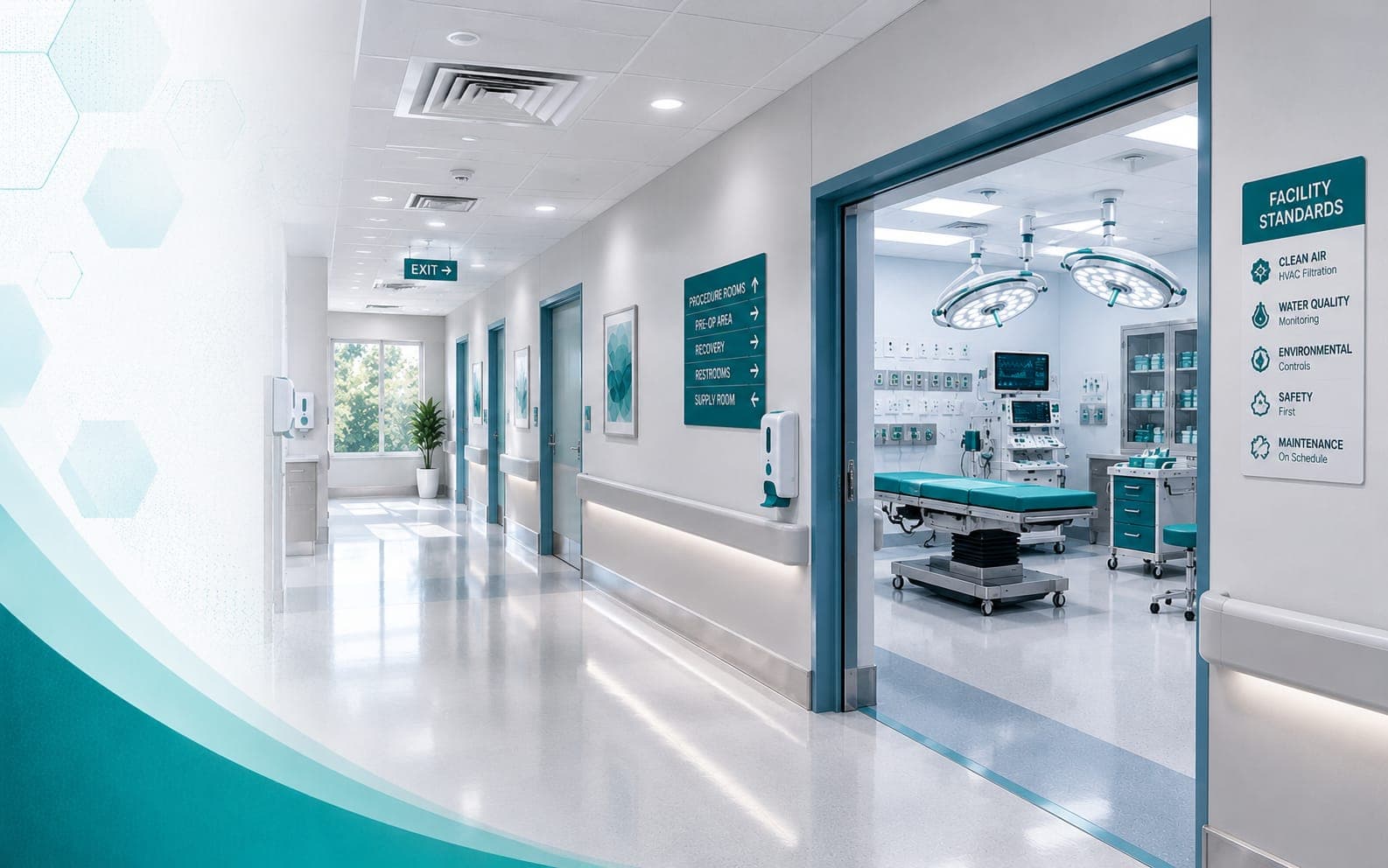
It's tempting to think of the building as the backdrop and the care as the quality. The College of Physicians & Surgeons of Alberta (CPSA) standard disagrees: in a non-hospital surgical facility, the physical environment is a control in its own right. NHS.3.0 (Physical Facilities) sets out what the space itself has to do so it doesn't quietly undermine safety, infection control, or privacy. It's the part of the Quality Management System you can't fix with a policy.
What CPSA expects
The section runs from floor plan to air handling. In plain language:
- Enough functional space for everything you do. Space that's adequate, functional, and reliable for the workload — without compromising quality, patient care, confidentiality, or safety — across applicable areas such as waiting, private changing, screening, washrooms, the service/procedure and reporting areas, recovery, reprocessing, soiled holding, storage, records, clerical/administration, and IT.
- Accommodations for safety, comfort, privacy, and access. An environment that protects safety, comfort, privacy, and confidentiality for all patients, including accessibility for those with disabilities or mobility equipment, secure storage for patients' belongings, clear signage, and a child-friendly setup where pediatric services are offered.
- Separation of incompatible activities. Instrument reprocessing is physically separate from patient-service areas, and the soiled/"dirty" holding area is kept apart from both patient areas and clean/sterile supplies. (This is where facilities and reprocessing meet.)
- A code-compliant design and adequate utilities. Design for efficiency, comfort, reduced injury and exposure risk, IPC, and proper lighting (meeting the applicable codes) with adequate electrical, emergency-power outlets, dedicated sinks, water, and enough piped oxygen, compressed air, and any other medical gases the service requires.
- HVAC that's compliant and maintained. A system designed to minimize infection and exposure, compliant with the applicable codes (including current CSA Z317.2), holding the right temperature, humidity, ventilation, pressurization, and air exchanges in critical areas — backed by a documented preventive-maintenance program with defined inspection, cleaning, and testing intervals. (See Appendix E.)
- Monitored, recorded environmental conditions. Temperature, humidity, ventilation, lighting and the rest are monitored and recorded against the applicable codes, kept in optimal ranges (roughly 20–23 °C and 30–60 % humidity), and adequate for equipment to run to manufacturer spec.
- Controlled medical gases. Monitoring and control of medical compressed-gas equipment, with new/modified piping installed and tested to code, and a safety protocol to inform the anesthesiologist and verify lines before any oxygen- interrupting maintenance.
- Secured access and adequate, safe storage. Access control over service rooms, health information, the information system, supplies, consumables, and medications; and storage that preserves the integrity and security of records, sterile and non-sterile supplies, medications and controlled substances, and PPE, stored to prevent cross-contamination.
- Clean, maintained, and code-compliant changes. The workspace is kept clean, uncluttered, and well maintained with regular waste/linen removal — and any new construction or structural change meets current codes and IPC requirements, with notice to users and IPC consultation.
Why facilities struggle with it
- Separation is "mostly." Clean and dirty flows cross somewhere (a counter, a cart route, a shared doorway), and the physical separation the standard requires isn't actually there.
- HVAC has no maintenance record. The system may be compliant; the evidence of filter, damper, and duct maintenance at the right intervals isn't.
- Environmental monitoring isn't logged. Temperature and humidity feel fine, but no one is recording them, so there's nothing to show.
- Storage outgrows the space. Supplies migrate into corridors and unsecured rooms; controlled substances and records aren't as locked-down as the standard expects.
What "getting it right" looks like
- A floor plan where clean and dirty never cross, with reprocessing and soiled holding genuinely separated.
- An HVAC preventive-maintenance log that matches the standard's intervals (filters, dampers, ducts, diffusers), kept as evidence.
- Environmental monitoring that's recorded, not just felt, with conditions held in the optimal ranges.
- Secured, adequate storage that preserves integrity and keeps records, medications, and controlled substances access-controlled.
How Zosimos helps
Facility requirements are where consulting earns its keep before a brick is laid: we help you read the design against the standard, get the separation and utilities right, and build the monitoring and maintenance logs that turn a compliant building into a demonstrably compliant one. Where those logs live in clipboards and spreadsheets, the Assets Management and Compliance Tracker tools we're building on the Zosimos Enterprise hub (launching soon) are designed to schedule and record them.
For non-surgical clinics: the patient-facing and general-facility pieces apply directly: functional space, accessibility, comfort and privacy, code-compliant design, lighting, secure storage, and cleanliness. The surgery-specific items (reprocessing/soiled separation, critical-area HVAC, piped medical gases) only apply if you reprocess instruments or administer anesthesia — but document why each one is marked not applicable.
See our compliance & accreditation support or get in touch if your clean-and-dirty separation or HVAC records wouldn't hold up to an assessment. Next in this series: before the procedure — patient selection, assessment & consent.
The care environment is one of the areas covered by our free readiness check for operating NHSFs.