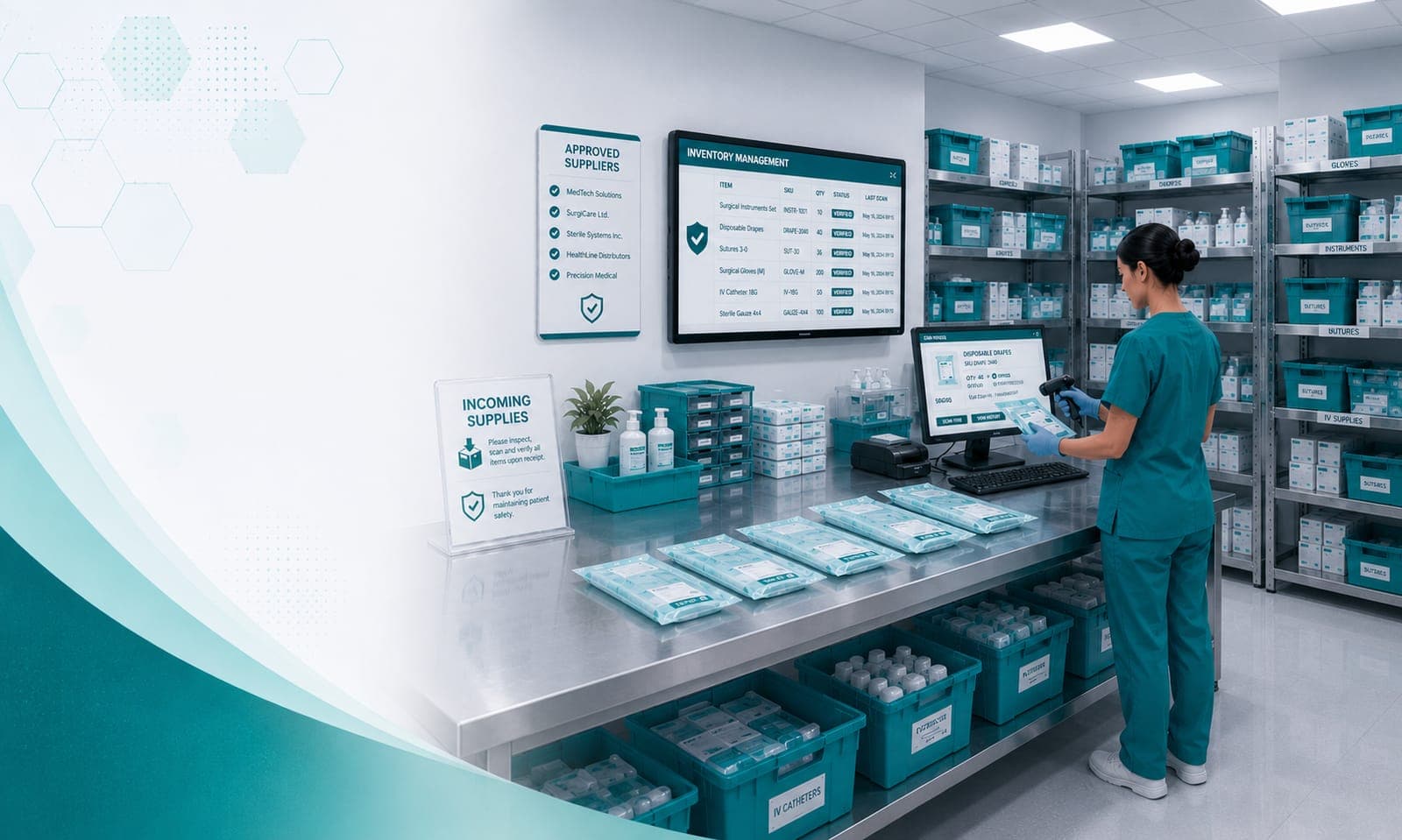
A surgical facility is only as safe as what it buys — the devices it implants and reprocesses, the drugs it administers, the outside services it relies on. So the College of Physicians & Surgeons of Alberta (CPSA) standard pulls purchasing inside the Quality Management System. It isn't procurement as a back-office errand; it's a controlled quality process with its own evidence trail.
What CPSA expects
The standard asks for documented control over every external service and supply that affects the quality of your care:
- Written policies for selecting and verifying purchased services, equipment, consumables, and supplies, covering supplier selection and approval, the requirements for what you're buying, and the review of supplier contracts so expectations are defined, documented, and understood.
- All equipment approved against the law. Equipment is approved according to the applicable national, provincial, and local legislation — a general requirement, separate from the device-specific licensing below.
- A list of accepted, approved suppliers. Not "the vendor we usually call" — a maintained list you can produce on request.
- Canadian licensing for reusable medical devices. Before you buy a reusable device, you confirm it holds a valid Canadian medical-device licence, comes from a distributor that carries an establishment licence, and meets the applicable legislation.
- A DIN for every pharmaceutical. When you buy a drug for use in services, you confirm it's properly licensed in Canada — that it carries a Drug Identification Number (DIN).
- Cross-functional purchasing decisions. Decisions about medical devices and equipment involve the people who will procure, use, reprocess, and maintain them, appropriate to the device's complexity, the manufacturer's specifications, its risk class, and intended use.
- Documented responsibilities when purchasing is shared. If a central purchasing department (or a parent organization) handles procurement, the split of responsibilities is written down.
Why this trips facilities up
- "We trust our vendor" isn't an approved-supplier list. Trust is not a control. The standard wants the list, the selection criteria, and the contract review.
- No licensing check at the point of purchase. A device without a confirmed Canadian licence, or a drug without a DIN on file, is a finding waiting to happen — and a patient-safety risk underneath it.
- One person buys; the reprocessing team inherits the problem. A device chosen without input from the people who reprocess it can turn out to be impossible to clean to standard, or incompatible with your sterilizer. The standard's cross-functional requirement exists precisely to prevent that.
- The paper trail lives in inboxes. Approvals, licences, and contract reviews scattered across email can't be produced as a system.
What "getting it right" looks like
- A maintained approved-supplier list, with suppliers verified at onboarding, and, as good practice, re-checked periodically after.
- Licensing captured at purchase (the device licence, the distributor's establishment licence, the drug's DIN) stored with the purchase record, not reconstructed at survey time.
- A cross-functional sign-off for new devices, looping in clinical use, reprocessing, and maintenance, which connects directly to your equipment lifecycle.
- Contracts reviewed against defined requirements, so what you expect and what the supplier delivers are the same thing, on paper.
How Zosimos helps
This is exactly where software built around the standard earns its keep. The Inventory & Procurement and Assets Management systems we're building on the Zosimos Enterprise hub (launching soon alongside PolicyHUB and our Accreditation Audit Tool) are designed to hold the approved-supplier list, attach device licences and DINs to the items they belong to, and keep the verification trail retrievable instead of buried. And because tooling without process still fails, our consulting team writes the purchasing policies and supplier-verification framework underneath it.
See our CPSA NHSF accreditation support or get in touch if you can't currently produce your approved-supplier list on demand. Next in this series: stakeholder feedback and complaint resolution.
Third-party arrangements are easy to overlook until an assessor asks for the agreement. Check where your facility stands across all eight domains.