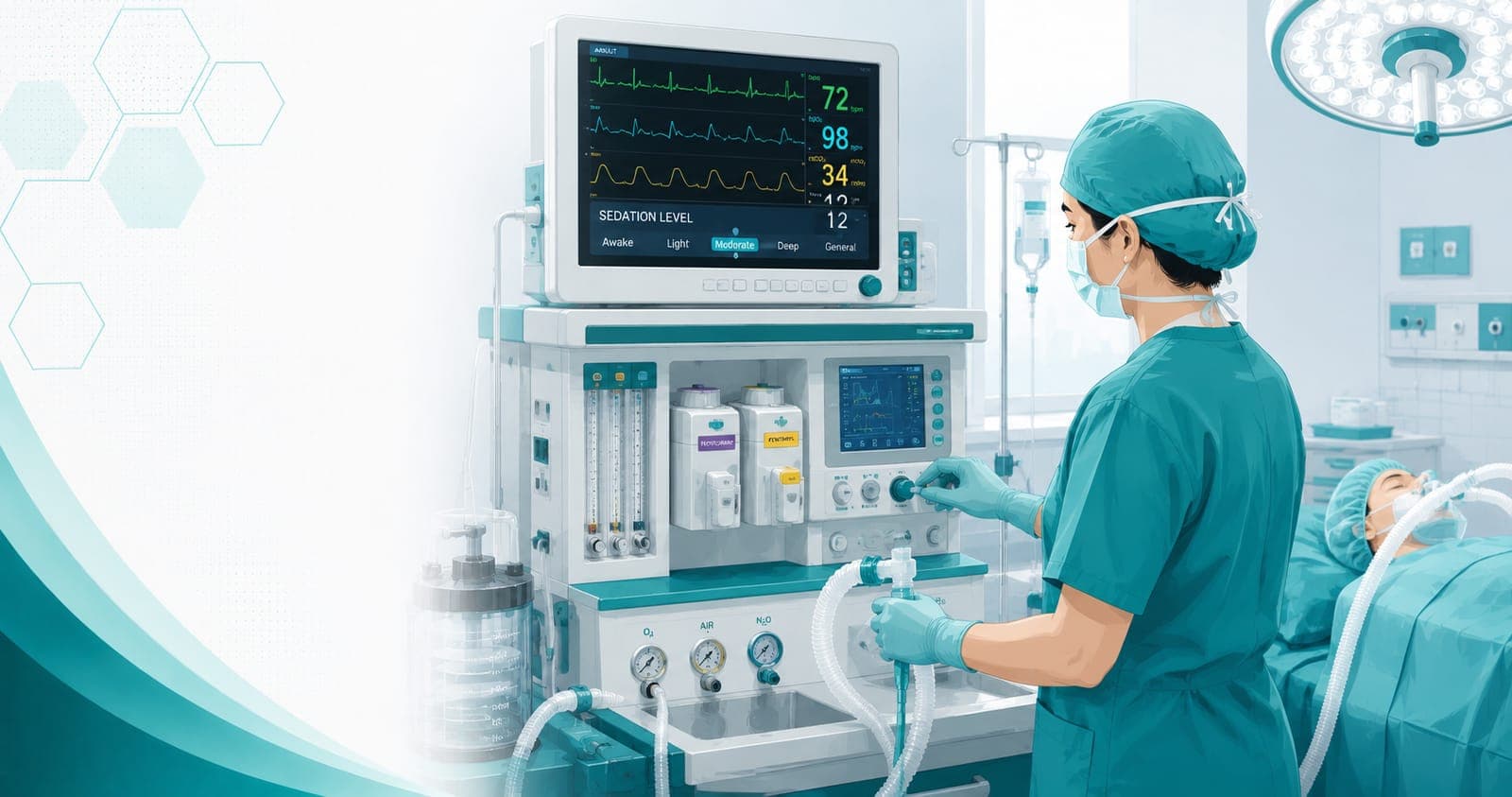
In a facility without a hospital's backup, anesthesia is the highest-stakes thing that happens, so the College of Physicians & Surgeons of Alberta (CPSA) standard gives it one of the most detailed sections in the whole document. NHS.9.14 governs who is suitable for anesthesia, how the equipment is checked, how the patient is monitored, and how the drugs are controlled. It's a dense part of the Quality Management System, but it comes down to a simple idea: nothing about anesthesia is left to assumption.
What CPSA expects
- Documented anesthesia policies. Written rules covering pre-anesthetic assessment, fasting, difficult or failed intubation, obstructive sleep apnea, local anesthetic systemic toxicity, fast-tracking to recovery, a pre-anesthesia checklist, equipment management, and post-anesthesia care.
- Confirmed patient suitability. A structured pre-anesthetic assessment by the anesthesiologist (or a privileged physician giving the anesthetic) — history, examination, test review, an ASA classification, and a signed anesthetic consent — with in-person consultation triggered by factors like a BMI of 40 or over (or under 18.5), ASA 3, or other significant comorbidities. The anesthesiologist is dedicated to the room from start to finish of each case.
- A pre-anesthetic machine check to Canadian Anesthesiologists' Society guidelines. Defined checks each surgical day (and after any workstation move or vaporizer change) and before every individual procedure: oxygen supply, leak testing, the scavenging system, monitor calibration and alarms, the breathing circuit, and ventilator readiness.
- Monitoring equipment matched to the anesthetic. Pulse oximetry, blood pressure, ECG, capnography, agent monitoring, and core-temperature measurement (required for any general anesthetic of 30 minutes or longer), with audible and visible alarms.
- A fully equipped anesthesia workstation for general anesthesia: oxygen analyzer, scavenging, disconnect/low-pressure alarms, pin-indexed agent-specific vaporizers, an immediately available alternate means of ventilation, a secondary oxygen source, and a 30-minute backup power supply.
- A complete airway cart (laryngoscopes, tubes, supraglottic and nasal airways, Magill forceps, a front-of-neck access kit, and a video laryngoscope available for difficult airways under general anesthesia), all on a standardized checklist.
- Safe patient-administered inhaled gas (Entonox / Penthrox): premixed gas from an approved supplier with no substitution, a filter changed between patients, documented screening and contraindication checks, no other sedating medication, and a dedicated second trained person continuously monitoring and recording vitals at least every ten minutes.
- A standardized anesthesia cart, stocked to a standard list, organized and clean, with labelled dedicated storage (TALLman lettering where needed), in-date stock, and multi-dose-vial dating rules.
- Medication safety and retained-item prevention: every medication and syringe labelled one at a time, anesthesia items kept separate from surgical items, and strict controlled-substances custody with a detailed log and witnessed wastage.
- Continuous intraoperative monitoring: the required parameters monitored and documented throughout every general anesthetic, regional anesthetic, and IV procedural sedation, with alarms enabled.
Why it's hard
- The machine check becomes routine — and routine becomes assumed. The standard's two-cycle check (each day and before each case) exists precisely to defeat "it was fine yesterday."
- Sedation gets treated as lighter than it is. The monitoring and documentation bar for IV procedural sedation is real, not optional.
- Controlled-substances custody slips. The detailed log and witnessed wastage are where audits find gaps.
What "getting it right" looks like
- A laminated pre-anesthesia checklist at each workstation, with the day-of and per-procedure machine checks documented per the Canadian Anesthesiologists' Society guidelines.
- Monitoring parameters documented, not just displayed — for every anesthetic and every sedation.
- A controlled-substances log that captures every dose, with witnessed wastage.
- A pre-anesthetic assessment with an ASA class and documented suitability on every record.
How Zosimos helps
We help facilities turn the anesthesia standard into airtight, evidenced practice: the policies and checklists it requires, and the records (machine checks, monitoring, controlled-substances logs) that prove it. The Compliance Tracker and Accreditation Audit Tool we're building on the Zosimos Enterprise hub (launching soon) are designed to schedule the checks and keep the logs reconciled and retrievable.
For non-surgical clinics: most of NHS.9.14 is OR-anesthesia-specific — but if your clinic provides IV procedural sedation, the monitoring, documentation, medication-labelling, and controlled-substances requirements carry over directly.
See our CPSA NHSF accreditation support or get in touch if your anesthesia records wouldn't show the full check-and-monitor trail. Next in this series: recovery room & safe discharge.
Sedation and anesthesia arrangements carry some of the heaviest evidence requirements in the standard. Self-assess your accreditation readiness to see whether yours are complete.